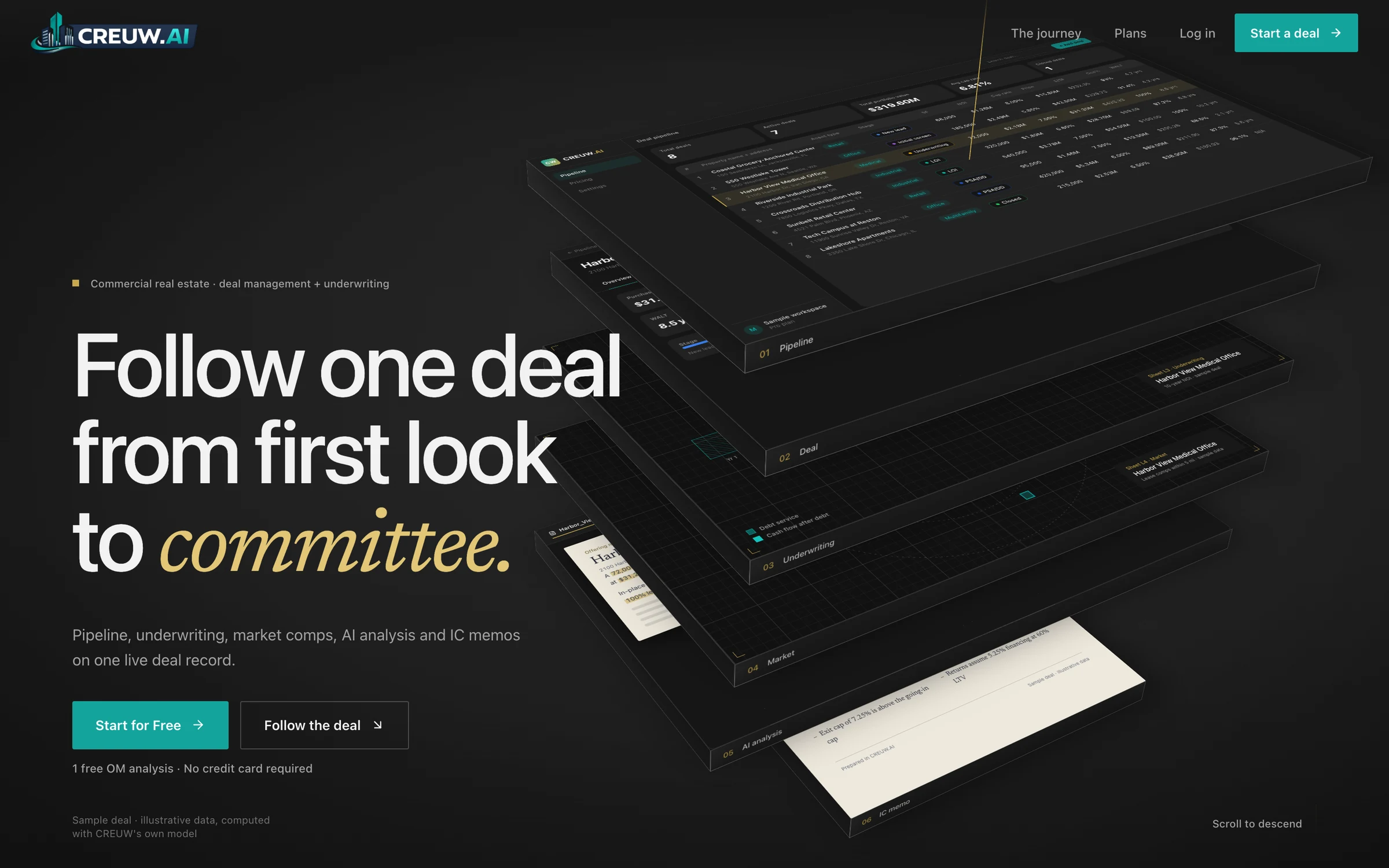
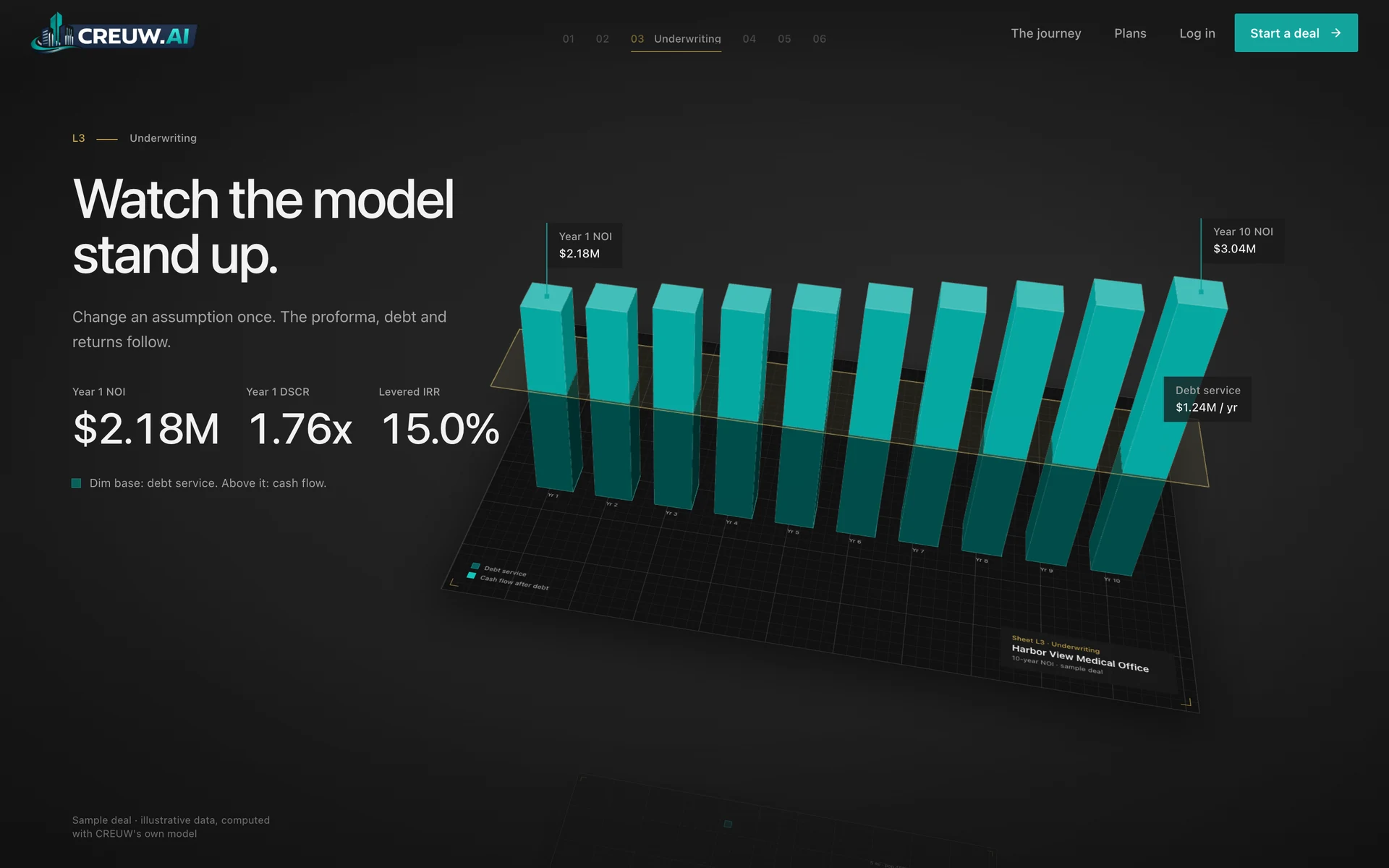
PipelineDealUnderwritingMarketAI analysisIC memo
CREUW AI
A commercial real estate platform that follows one deal from first look to investment committee.
Applications and platforms designed around how your business actually runs, then engineered so the tenth feature is as easy to ship as the first.
The name on the brief says little. The parts it is made of say almost everything about cost, risk and time.
SaaS platform: One product, many customers, each seeing only their own world.
Marketplace: Two kinds of people who need to find, and trust, each other.
Dashboard: Scattered numbers, brought into one view a team can act on.
Customer portal: A signed-in place where customers help themselves.
E-commerce: A catalogue, a checkout and everything that happens after the order.
Internal platform: The tool that replaces the spreadsheet everyone is afraid to touch.
Modernisation: A working product, moved onto foundations that will hold.
Web development at SOLOGEN means designing and engineering software that runs in the browser: customer-facing applications, SaaS platforms, dashboards, marketplaces, portals and the internal systems that connect them.
Web products sit on a staircase. Each step up includes everything below it, and we build at every level.
Fast on a phone, easy for your team to update, structured so search engines and people both find what they came for.
People log in and do their work in it. Permissions, data that must stay correct, and screens for the awkward cases as well as the happy path.
Subscriptions, payment providers, the systems you already run and the background work that keeps them all in step.
Many customers, heavy data, several teams shipping at once. Architecture, monitoring and release practices carry as much weight as features.
How data, services and interfaces fit together is decided first, and written down. It is why the tenth feature costs about what the first did.
What renders on the server, what loads later and what never reaches the browser at all are choices made at the start, when they are cheap.
The people drawing the interface and the people building it work on the same product at the same time, so what is designed is what ships.
Readable code, documentation and a clear deployment path. Your product should never depend on one person's memory, including ours.
Proven tools, chosen for the product and the team that will own it. Open a layer to see why each choice matters.
Everything people see and touch in the browser.
The frontend decides how fast a product feels and how easily search engines can read it. The right choice keeps pages quick as features are added.
The logic, APIs and integrations behind the interface.
The backend carries your business rules. A well-structured one makes new features cheap and keeps the product stable when usage climbs.
Where your product's information lives and stays correct.
Data outlives code. The right model keeps information consistent, queries fast and future reporting possible.
Where the product runs, scales and recovers.
Infrastructure decides reliability and running cost. We fit the platform to your scale, your team and any systems you already use.
The same team stays on. Launch is where the most useful information starts arriving.
Monitoring and alerts are live before the launch is. We stay close while real traffic finds what testing could not.
Real users do unexpected things. Those findings are triaged against the goals you set at the start, and the important ones are shipped quickly.
A regular rhythm of review and release. The roadmap is rewritten from what the product has taught you.
Custom web applications, SaaS platforms, dashboards, marketplaces, customer portals, e-commerce and internal business systems. Most products turn out to be two or three of these at once, which is why we start from the business problem instead of a product category.
Yes. Product design is one of our five disciplines, and designers work alongside the engineers building your product. You can also bring existing designs and we will build from those.
Yes. We begin by reading the code and the data model, then propose changes in steps your team can release one at a time. A full rewrite is a last resort, and we will tell you when it is not needed.
Most often React and Next.js with TypeScript on the frontend, Node.js, NestJS or .NET on the backend, PostgreSQL for data, and AWS, Azure or GCP for infrastructure. The choice follows the product and the team that will own it.
The same team stays on. We monitor the product, fix what real usage reveals, and plan the next release with you. Launch is where the most useful information starts arriving.
Tell us what you are building in the project brief. It takes a few minutes and gives us enough to come back with the right people and the right questions.
PipelineDealUnderwritingMarketAI analysisIC memo
A commercial real estate platform that follows one deal from first look to investment committee.



A platform that helps patients understand aesthetic treatments and find the right practitioner before a first appointment.